
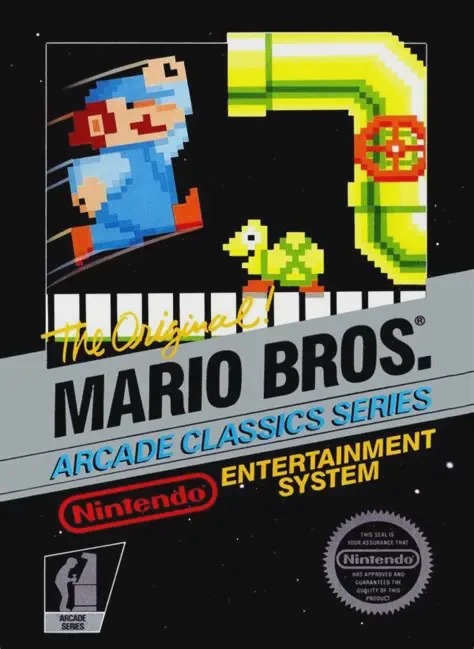
Mario Bros.
Game Description
Game Overview
Mario Bros. is a fixed-screen platform game developed by Nintendo R&D1 (with Intelligent Systems assisting on the Famicom/NES port) and published by Nintendo. The original arcade version launched in 1983, followed by the Famicom release in Japan on September 9, 1983, and the NES versions in North America (June 1986) and Europe (September 1986).
Mario (and Luigi in two-player mode) work as plumbers clearing creatures emerging from sewer pipes. The single-screen layout features multiple platforms connected by pipes in the corners. Enemies continuously spawn and move across the platforms. To defeat them, players jump and hit the platform from underneath, flipping the enemy onto its back. The player must then quickly run into the flipped enemy to kick it off the screen before it rights itself and becomes faster and more aggressive.
A central POW Block can be hit (limited uses) to flip all grounded enemies at once. Bonus stages appear periodically, challenging players to collect as many coins as possible within a time limit. The game supports simultaneous two-player play, allowing cooperative teamwork or competitive rivalry. Difficulty increases steadily with new enemy types and denser waves. This title established key Mario series elements, including Luigi’s debut, Mario’s plumber identity, and the POW Block, while remaining a pure, addictive arcade-style experience distinct from the later side-scrolling Super Mario Bros.
Quick Specifications
- Title: Mario Bros.
- Platform: NES / Famicom (originally Arcade)
- Developer: Nintendo R&D1 (Intelligent Systems for NES port)
- Publisher: Nintendo
- Release Dates: Arcade – 1983; Famicom – September 9, 1983 (Japan); NES – June 1986 (North America), September 1986 (Europe)
- Genre: Platform / Action
- Players: 1–2 (simultaneous co-op or competitive)
- Playable Characters: Mario and Luigi
- Notable Firsts: Luigi’s debut as a playable character; Mario established as a plumber
Key Features
- Fixed single-screen platform layout with wraparound sides
- Core mechanic of flipping enemies by bumping platforms from below, then kicking them off
- POW Block that flips all grounded enemies (limited uses per stage)
- Multiple enemy types: Shellcreepers, Sidesteppers (require two hits), Fighter Flies, Slipice, and fireballs
- Bonus coin-collection stages
- Simultaneous two-player mode for cooperative or competitive play
- Steadily increasing difficulty with denser enemy waves
- Simple but precise controls focused on timing and positioning
Frequently Asked Questions (Q&A)
How do you defeat enemies in Mario Bros.?
Jump and hit the platform directly beneath an enemy from below to flip it onto its back. Then quickly run into the flipped enemy to kick it off the screen before it recovers.
What is the POW Block?
The POW Block sits in the center of the screen. Hitting it from below flips all enemies that are currently standing on platforms. It has a limited number of uses but is replenished after bonus stages.
Can two players play at the same time?
Yes. Mario Bros. supports simultaneous two-player play. Players can cooperate to clear stages or compete for points and survival.
Is this the same as Super Mario Bros.?
No. Mario Bros. is a fixed-screen arcade-style game focused on clearing enemies from platforms. Super Mario Bros. (1985) is the side-scrolling adventure that defined the modern Mario formula.
Why is Mario Bros. historically important?
It is the first game to feature Luigi as a playable character, the first to establish Mario as a plumber, and the debut of the POW Block. It also helped popularize simultaneous two-player platforming.
Download Resources
Download directly from this site, or use a cloud drive link below
⚠️ Download Tips:
- Use extraction software (e.g., 7-Zip, WinRAR) to extract the downloaded files
- Put the extracted ISO or CSO files into the ISO folder of your PSP memory card
- Make sure your PSP has custom firmware (CFW) installed